Contact Info
Learn why discount credit card processing is trending as businesses combat inflation and discover how dual pricing models can eliminate processing fees entirely.
Discount credit card processing is a pricing model where you offer customers two prices: one for cash and one for card payments. The card price includes the processing fee. The cash price doesn’t. It’s that straightforward.
When someone pays cash, they get a discount. When they pay by card, they cover the cost you’d normally absorb. You’re not adding a surprise fee at checkout—you’re being upfront about the real cost of different payment methods. This transparency is what separates discount programs from traditional credit card surcharging, and it’s why customers tend to respond better to it.
The model goes by a few names—cash discounting, dual pricing—but the concept stays the same. You post both prices clearly, and your customer decides which works for them. No hidden fees, no surprises, just honest pricing that reflects the actual cost of accepting cards.

Here’s how it plays out in real time. Let’s say you run a retail shop in Annapolis or Alexandria. You sell a product for $100. Under a dual pricing model, that $100 is your card price—it already includes the roughly 3% fee processing cost baked in.
When a customer comes to the register and pays with cash, your system automatically applies a 3% discount. They pay $97. You receive $97. No processing fee eats into it.
If they pay by card, they pay the full $100. The merchant service costs get deducted, and you still net around $97. Either way, you’re keeping the same amount. The difference is that the customer paying by card covers the cost of their payment method, not you.
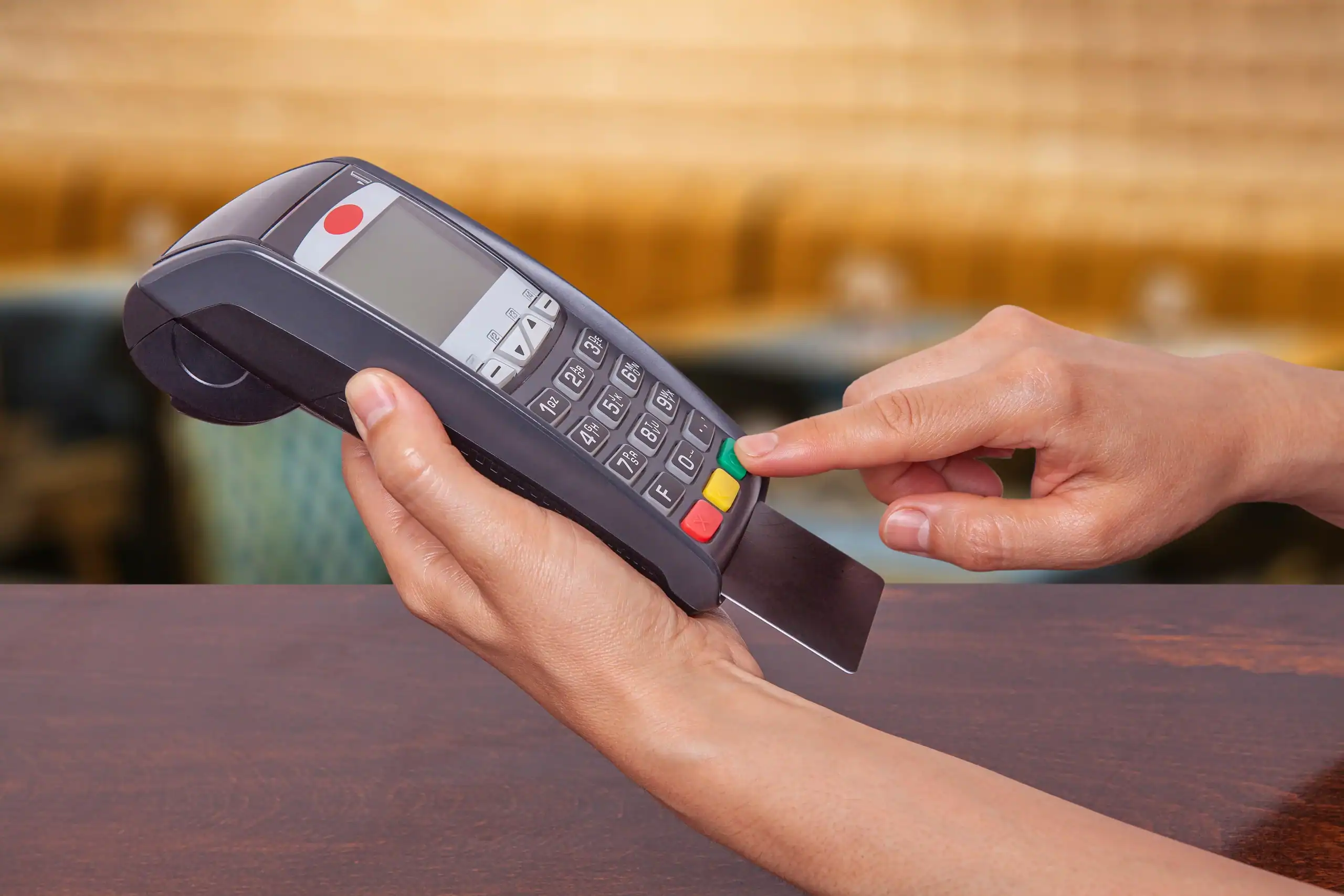
Your point-of-sale system handles this automatically. Modern payment terminals are built to recognize payment type and adjust pricing accordingly. You’re not doing mental math at the register or confusing your staff. The technology does the heavy lifting.
Signage is key. You need clear notices at your entrance and point of sale explaining the pricing structure. Customers should know before they reach the register that paying cash saves them money. This isn’t about tricking anyone—it’s about giving them a choice and being transparent about why prices differ.
Most businesses find that once customers understand the model, there’s little pushback. Some choose cash to save a few dollars. Others stick with cards for convenience and rewards. Both options work, and you’re no longer subsidizing one over the other.
The beauty of this approach is simplicity. You’re not raising prices across the board or cutting into your margins. You’re just aligning your pricing with the actual cost of doing business, and customers appreciate that honesty more than you’d expect.
One of the biggest concerns business owners have is legality. Can you actually do this? The short answer: yes, and it’s protected by federal law.
Cash discount programs are legal in all 50 states, including Maryland, Virginia, and DC. The Durbin Amendment, part of the Dodd-Frank financial reform legislation, protects your right to offer discounts for cash payments. This is different from credit card surcharging, which adds a fee specifically for credit card use and faces restrictions in several states.
The distinction matters. Surcharging is illegal in states like Connecticut, Maine, and Massachusetts. Even where it’s allowed, you’re capped at 4% federally and often face stricter state-level rules. Maryland allows surcharging up to 4%, Virginia permits it with disclosure requirements, and DC has no specific prohibition. But navigating those rules can get complicated.
Cash discounting sidesteps all that. You’re not charging extra for cards—you’re rewarding cash. It’s framed as a benefit, not a penalty. Psychologically, that makes a huge difference. Customers don’t feel punished for using their preferred payment method. They feel like they’re getting a deal if they choose cash.
Card networks like Visa and Mastercard have their own rules, of course. You need to ensure your program is set up correctly—proper signage, accurate receipts, and clear communication. But when implemented right, cash discount programs meet all compliance requirements without the regulatory headaches that come with surcharging.
The legal clarity is one reason these programs have exploded in popularity. Business owners don’t want to gamble with compliance. They want a solution that works, saves money, and doesn’t put them at risk. Cash discounting checks all those boxes.
If you’re working with a reputable payment processor, they’ll guide you through setup and make sure you’re compliant from day one. It’s not something you need to figure out alone, and it’s definitely not something you should avoid just because you’re unsure about the rules.
Want live answers?
Connect with a Merchant Pro Inc expert for fast, friendly support.
Timing matters, and right now the timing couldn’t be better for discount credit card processing. Inflation isn’t going away. Projections show it hovering around 3% through the end of 2026. Tariffs added about 0.7 percentage points to overall inflation in 2025, and those costs are still filtering through to businesses across the DMV area.
On top of that, credit card usage keeps climbing. It’s now the most popular payment method in the U.S., accounting for over 32% of consumer purchases. More card transactions mean more fees. For businesses already squeezed by rising costs, those fees become impossible to ignore.
Small business owners are feeling it. Many are delaying growth plans, working longer hours, and scrambling to find ways to cut expenses without sacrificing quality or customer experience. Discount credit card processing offers a rare win: you reduce costs without changing your product, your service, or your team.

Let’s put some numbers to it. If you’re processing $50,000 a month in credit card sales at an average rate of 2.5%, you’re paying $1,250 monthly in fees. That’s $15,000 a year. For a business doing $100,000 monthly, you’re looking at $30,000 annually.
Even a small change in your effective rate makes a massive difference. A 0.2% shift might not sound like much, but for a business processing $600,000 annually, that’s $1,200. For high-volume businesses, it can hit six or seven figures.
These aren’t one-time costs. They’re recurring, month after month, year after year. And they’re unpredictable. Interchange fees fluctuate based on card type, transaction method, and a dozen other factors. That variability makes budgeting harder and planning for growth nearly impossible.
Discount credit card processing eliminates that volatility. You know exactly what you’re keeping from every sale because you’re not losing a percentage to fees. Your cash flow becomes predictable. You can forecast accurately. You can invest in growth without worrying that processing costs will eat into your returns.
It’s not just about saving money—it’s about stability. When your margins are tight and every dollar counts, knowing your costs aren’t going to spike unexpectedly gives you breathing room. You can focus on running your business instead of constantly reacting to fee increases or surprise charges on your monthly statement.
The businesses that have made the switch report similar results: thousands saved annually, better cash flow, and the ability to reinvest those savings into inventory, marketing, or staff. One case study showed a family-owned store cutting monthly fees from $3,200 to zero—nearly $40,000 saved in a single year. Those aren’t marginal gains. That’s real money back in your pocket.
Here’s the concern every business owner has: will customers hate this? Will they feel nickel-and-dimed? Will they take their business elsewhere?
The data says no. When implemented correctly, dual pricing doesn’t drive customers away. In fact, many appreciate the transparency. They understand that credit cards cost money to process. They’ve seen surcharges at gas stations for years. Offering a discount for cash feels fair—maybe even generous.
The key is framing. If you present it as “we’re charging you extra for using a card,” people get annoyed. If you present it as “you save money when you pay cash,” they see it as a benefit. It’s the same transaction, but the psychology is completely different.
Signage matters here. Clear, visible notices at your entrance and register explaining the pricing model set expectations before anyone reaches the counter. Your staff should be trained to answer questions calmly and confidently. Most customers won’t ask—they’ll just see the two prices and make their choice.
Some will switch to cash. Others won’t. And that’s fine. You’re not trying to eliminate card payments. You’re just trying to stop losing money on them. Even if 80% of your customers still pay by card, you’re no longer absorbing the cost for that 80%. The 20% who switch to cash are a bonus.
Studies show that about 98% of customers continue paying by card even when a cash discount is offered. Convenience wins. But those customers are now covering the cost of that convenience, which is exactly how it should be. You’re still providing the service. You’re just not paying for it.
Customer satisfaction doesn’t drop. Chargebacks decrease because more people are paying cash. And your profit margins improve without raising prices or cutting corners. It’s one of the few strategies where everyone actually wins.
Inflation isn’t slowing down. Processing fees aren’t going away. But you don’t have to keep absorbing costs that are eating into your profits. Discount credit card processing gives you a clear, legal, and customer-friendly way to protect your margins while still offering payment flexibility.
Whether you call it dual pricing, cash discounting, or fee processing, the concept is the same: align your pricing with the real cost of doing business. Be transparent with customers. Give them a choice. And stop losing money every time someone swipes a card.
If you’re ready to take control of your payment processing costs and see how much you could be saving, we can walk you through the setup, ensure you’re compliant, and help you implement a program that works for your business and your customers.
Summary:
Share: